Conference Showroom vs. YouTube Playlist
Sam
Content Writer, Speechbox
Conference Showroom vs. YouTube Playlist - The Honest Answer
The honest answer is that these are not two competing destinations. A YouTube playlist is a video host. A conference showroom is the navigable, searchable destination built on top of a host. The strongest setups use both: YouTube hosts the video files, and the showroom is the layer the audience actually explores.
The real question most organizers are asking is narrower. Is a bare YouTube playlist enough on its own? For a small internal recording, yes. For a 20-plus session public conference with speakers, sponsors, and an audience that exists on search and social, no. The playlist holds the videos. It does almost nothing to make them found, navigated, or cited six months later.
What a YouTube Playlist Does Well
A playlist is the right floor, not the ceiling. It is free, reliable, and the most-used video search engine in the world sits on top of it. Uploading every session to an unlisted or public playlist is a reasonable first step, and YouTube as the underlying host is genuinely the correct choice.
What a playlist gives you: durable hosting, no storage cost, native YouTube search and recommendations, and a link you can drop into a recap email. For a single keynote or an internal all-hands that nobody needs to navigate, that is the whole job. The video exists, it has a URL, done.
The problem starts when the playlist is the only thing the conference ships. A playlist is a list. It does not know your event had tracks, stages, days, topics, or speakers. It cannot answer a question. It cannot be branded as your event. And to an AI search engine, it is a wall of video files with thin metadata, not a structured answer to anything.
A YouTube Playlist Alone
- Hosts every session video reliably and for free
- Searchable inside YouTube, recommended by YouTube
- One link to paste into the recap email
- No navigation by topic, speaker, day, or stage
- No written layer, so almost nothing is indexed by Google text search
- Thin metadata, so AI engines rarely cite it
- Carries the YouTube brand, not your event brand
- No place for sponsor sections or speaker entry points
A Showroom Built on Top of YouTube
- Uses YouTube as the underlying video host, no duplicate uploads
- Navigable by topic, speaker, day, and stage
- Full transcript and chapter markers per session, indexable as text
- A written magazine layer that Google and AI engines can read
- Structured data so ChatGPT, Perplexity, and Gemini can cite sessions
- Branded as your event, not a generic platform
- Dedicated sponsor sections and per-speaker entry points
- One permanent destination the audience returns to between events
What a Showroom Adds On Top
A conference showroom does not replace YouTube. It sits on top of it and adds the layer a playlist was never built to provide: discovery, navigation, and citability.
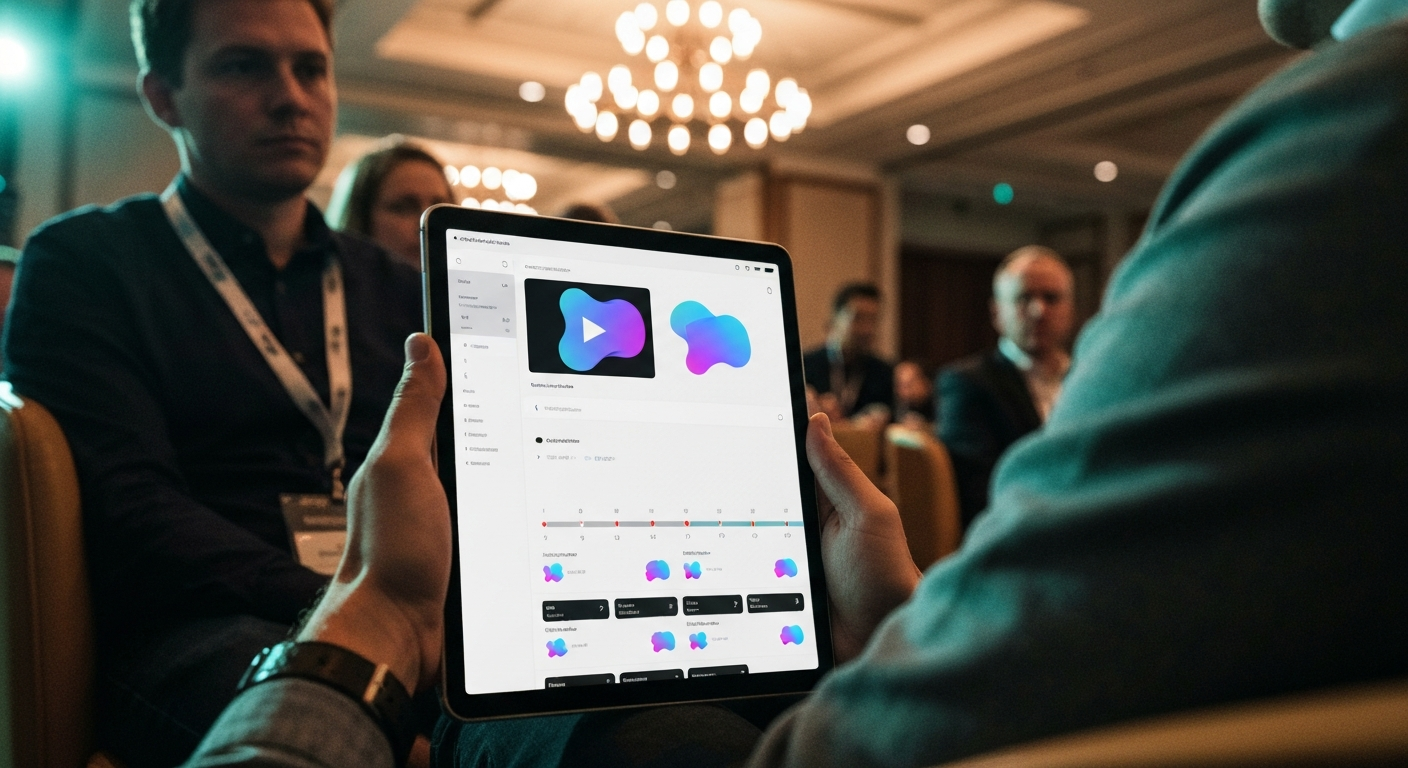
The showroom is where a visitor who never attended can land on a single session, read the transcript, jump to the chapter they care about, and follow a topic thread into three related talks. It is where a speaker sends their network to one branded page instead of a raw video link. It is where a sponsor owns a named topic section that accrues a full year of traffic. And it is the surface structured cleanly enough that AI search engines treat your sessions as a citable source rather than an opaque video file.
Navigation a List Cannot Provide
Browse by topic, speaker, day, and stage. A visitor finds the one session out of forty that answers their question in seconds, instead of scrubbing a playlist.
A Text Layer That Gets Indexed
Full transcripts, chapter markers, and recap articles per session. Google indexes text, not video frames. The written layer is what surfaces in organic search.
Structured for AI Citation
Clean metadata, entity attribution, and schema so ChatGPT, Perplexity, and Gemini can cite a session when someone asks about the topic months later.
Sponsor Sections and Speaker Pages
Named sponsor topic areas and per-speaker entry points. A playlist has no concept of either. The showroom turns both into durable, measurable inventory.
They Are Not Enemies
The mistake is framing this as the showroom against YouTube. The video files still live on YouTube. The showroom pulls them in, wraps them in navigation and a written layer, and brands the experience as your event. There are no duplicate uploads and no second storage bill. YouTube does what it is best at, hosting and serving video. The showroom does what YouTube was never built for, which is being a findable, branded, citable destination for one specific conference.
This is also why "just put it on YouTube" and "build a showroom" are not the same decision at different price points. They are different layers of the same stack. The honest comparison is between shipping only the host layer versus shipping the host plus the destination layer.
When a Playlist Alone Is Enough
A bare playlist is the right call in a few real cases. An internal company all-hands recorded for employees who missed it. A single keynote with no other sessions to navigate. A one-time event with no recurring audience and no sponsors to report to. A budget that genuinely cannot support anything beyond hosting this cycle.
In each of these, the navigation, the written layer, and the citation surface add little, because there is no audience returning to explore and no sponsor or speaker depending on the visibility. The playlist holds the video, and the video is all that was needed.
How to Choose

Four questions settle it for a specific event.
First, does anyone need to navigate the content. One video needs no navigation. Forty sessions across three tracks need it badly.
Second, does the content need to be found by people who were not in the room. If the answer is yes, you need the text layer and the structured data, and a playlist provides neither.
Third, do speakers or sponsors depend on the visibility. Speakers want one branded page to share. Sponsors want a section that accrues traffic and produces a report. A playlist gives them a raw link and nothing to measure.
Fourth, is this a recurring event. A recurring conference benefits from a permanent destination the audience returns to between events. A one-time event has a shorter tail, and a playlist may be enough.
If three of these point to navigation, discovery, speakers, or recurrence, the playlist alone is leaving the value on the table. Keep YouTube as the host and add the destination on top.
Speechbox and the Destination Layer
Speechbox builds the conference showroom as the destination layer on top of YouTube, which stays the underlying video host. Sessions are pulled in with full transcripts, chapter markers, topic navigation, a written magazine layer, sponsor sections, and per-speaker pages, all generated during and immediately after the event and reviewed by a human before publication. The result is one branded, searchable, citable destination, without a second video upload or a second storage cost.
For organizers who already have a YouTube playlist from last year, the practical move is to keep it as the host and layer the showroom over it, rather than starting over. The video files do not move. The destination is what changes.
Related Terms
- What Is a Conference Showroom? - The full definition of the post-event destination, its surfaces, and who it serves.
- Conference Media Infrastructure - The end-to-end stack that produces the showroom alongside live experiences and speaker kits.
- How Conferences Repurpose Session Content - The repurposing model that fills the showroom with clips, articles, and quote cards.
- How Conference Content Gets Cited by AI Search Engines - Why the structured showroom layer, not the raw playlist, is what AI engines cite.
Related Questions
- What is a conference showroom?
- Can I use YouTube as the video host for a conference showroom?
- Why do conference YouTube playlists get so few views after the event?
- How do AI search engines cite conference session videos?
- What is the difference between hosting conference video and distributing it?
- How do speakers and sponsors use a conference showroom?
- Is a YouTube playlist enough for a small or internal event?
- How do I turn last year conference playlist into a navigable destination?
Want to see how this works on your footage?
Let's connect