How Conference Content Covers the Full Marketing Funnel
Sam
Content Writer, Speechbox
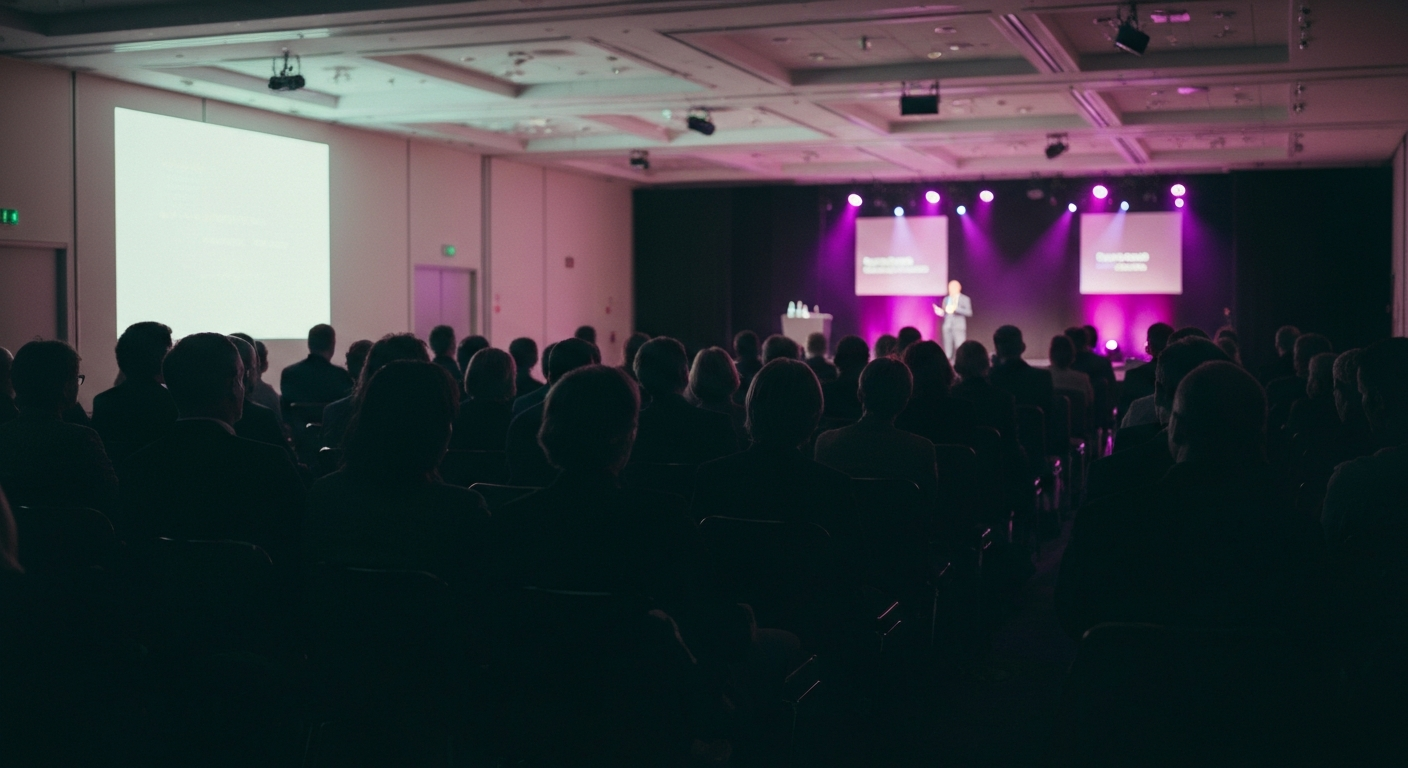
How Conference Content Covers the Full Marketing Funnel
Short answer: one conference video covers all four stages of the 2026 marketing funnel at the same time. Awareness, consideration, conversion, retention. Most marketing technology vendors own one row of the funnel and need a different data input for each. Conference content is the rare input that feeds every row from a single source, when the processing layer is built to derive funnel-specific assets in one pass instead of four.
This is the operating model that lets a single two-hour event replace the output of four separate vendors across the entire 12-month marketing window that follows it.
The Default Pattern Most Conferences Run
Conference organizers usually treat the marketing funnel the way most categories do. One tool per row.
A social listening tool sits in awareness. An email marketing platform sits in consideration. A CRM and ecommerce stack sit in conversion. A loyalty platform sits in retention. Each vendor solves one box, each requires a different data input, each runs against its own operations team and its own budget line. The funnel gets covered, in a way, but the coverage is fragmented and the cost is paid four times.
The assumption underneath that pattern is that the input data for each stage is different. Data for a social campaign is not the same as data for a leadgen form is not the same as data for an onboarding sequence. In most categories that assumption holds. In events, it breaks. Every minute of what happens on stage is one extremely rich input, and splitting that input across four separate vendors is an operational defect, not a methodology.
The Four Funnel Stages, Derived From One Video Spine
Awareness
Attract new visitors. The framework recommends SEO research, content marketing, and social ads. The conference video provides the raw material for all three when it is segmented and tagged at capture.
Consideration
Deepen interest and nurture leads. The framework recommends email marketing, landing pages, and webinars. The same video spine produces newsletter copy, long-form articles, and an indexed showroom of session pages.
Conversion
Drive sales. The framework recommends checkout optimization, CRM integration, and personalized offers. Speaker kits and showroom evidence are the personal proof that closes renewal and sponsor conversations.
Retention and Advocacy
Keep customers and turn them into ambassadors. The framework recommends loyalty programs and repeat engagement. Year-round showroom access and personal speaker kits turn the audience and the speakers into compounding distribution.
Stage 1: Awareness
The 2026 funnel framework places SEO research, content marketing, and social media ads in the awareness row. The job of this stage is to put the brand in front of new audiences.
A conference video processed through a custom engine produces, from the same single input:
- Highlight clips formatted for LinkedIn, X, YouTube Shorts, and Reels.
- Quote cards that work as visual social posts.
- Thread hooks that anchor long-form social threads.
- YouTube boosters: titles and descriptions tuned for organic search based on which segments of the video earned attention.
- Citations inside AI search engines like ChatGPT, Gemini, and Perplexity, via an AEO pipeline that turns session moments into discoverable answers.
The mechanic worth holding onto is the tagging layer. Each asset is generated already labeled by speaker, by topic, and by funnel stage. That tagging is what separates this output from generic clip dumping. Awareness assets can be targeted at the audiences they were segmented for, instead of being pushed out as undifferentiated highlight reels. A clip tagged for awareness goes into a paid social pool. A clip tagged for consideration goes into the newsletter pipeline. A clip tagged for retention is scheduled into the 12-month evergreen rotation. The same video produces all three, routed automatically.

Stage 2: Consideration
The consideration row recommends email marketing, optimization, landing pages, and webinars. The job is to deepen interest and nurture leads once the awareness assets have done their work.
From the same conference input, the consideration assets are:
- Blog posts long enough to feed a newsletter capture and a nurture sequence.
- Newsletter copy ready to send.
- A long-form website article that builds organic authority over months.
- Showroom session pages: dedicated landing pages for every session, indexed, transcribed, and schema-marked, that stay live for the full year after the event.
- Speaker kits that act as high-intent landing experiences for the individual speakers and the people who searched for them.
The difference between a showroom and a webinar replay platform is the indexing layer. A webinar produces one asset that decays inside 90 days. A showroom produces a folder of indexable, schema-marked landing pages that keep pulling organic traffic for the remainder of the year, because each session is treated as a discrete, searchable, citable surface.
Stage 3: Conversion
The conversion row recommends ecommerce platforms, checkout optimization, CRM integration, and discounts or promotions. The job is to turn intent into a transaction.
In the conference context the conversion assets are:
- Speaker kits used as personal evidence by sponsors evaluating their renewal for the following year.
- Showroom presented as a proof asset when organizers sell sponsor packages for the next edition. A 2026 showroom is the strongest possible piece of evidence in front of a 2027 prospect.
- Video descriptions that enrich the product pages where conversion conversations happen.
- High-intent moment segmentation inside sessions, which the marketing team can pull into precision retargeting campaigns.
The clearest field data point is the Israeli Business Channel deal. The channel purchased 10 speaker kits on the evening of the event itself. The order closed not in a classical sales motion but in response to the personal evidence: the speakers saw their finished kits, the buy decision was made in the same window as the experience. That is a different motion than a checkout funnel, and a more efficient one, because the decision compresses into the moment of value.
Stage 4: Retention and Advocacy
The retention row recommends loyalty programs, repeat purchases, customer service, and email updates. The job is to keep customers engaged and turn them into ambassadors.
The retention assets a video spine produces:
- A year-round showroom that keeps the conference experience accessible to attendees who want to return to a session they remember or share one with a colleague.
- A pacing schedule of highlight clips that releases content across the full 12 months after the event, refreshing the conference in the memory of people who will buy a ticket for the next edition.
- Speaker advocacy. Every speaker receives their own speaker kit and shares it inside their professional network. Speakers become organic distribution, without a formal loyalty program attached.
- Sponsor recap kits that act as renewal evidence the following year. A sponsor whose logo appeared on clips that accumulated 12 months of impressions has a much easier conversation with their CFO at renewal time.
The critical mechanic in this stage is speaker advocacy. A speaker who shares their own kit creates exposure inside their professional network, a network the organizer could rarely have purchased through ad spend. Of every distribution mechanism available in 2026, organic share inside a high-trust professional network is the one whose economics still work.

Why the Fragmented Pattern Is Also an Operational Problem
A conference organizer running the default model is procuring four vendors. A social agency, an email marketing team, a landing page vendor, a video editing vendor. Each needs its own input, its own briefing, its own timeline, its own invoice. The total budget is high and the velocity is slow, because each vendor only sees the slice of the funnel it owns.
A single video spine collapses the four vendors into one input and one pipeline. The savings are real, but the bigger story is quality. The awareness assets are derived from the same semantic processing of the video that produced the retention assets. The story is consistent because the source is consistent. A funnel built from four separate inputs cannot be coherent in the same way, because the inputs themselves disagree.
The Contrarian Position
The 2026 marketing technology category is built on the assumption that funnel inputs are fragmented. Four tools, four integrations, four teams, four invoices. The conference video breaks that assumption. It is a single input rich enough to derive every funnel stage in one pass, when the processing layer is designed to do that derivation deliberately instead of producing four content tracks in parallel.
The vendor who recognizes this first wins the category. The vendors who keep optimizing for one row at a time are competing against a model that has already collapsed the rows.
Related Terms
- Conference Media Infrastructure
- The Four Pillars of Conference Infrastructure
- What Is a Speaker Kit
- What Is a Conference Showroom
- AI for Event Content
Related Questions
- How does conference content fit into a marketing funnel?
- Can one video really cover all four marketing funnel stages?
- What conference assets feed top-of-funnel awareness campaigns?
- How do speaker kits work as bottom-of-funnel sales evidence?
- Why do most conferences only repurpose conference content for social media?
- What is the difference between a conference showroom and a webinar replay?
- How long can a single conference video keep producing marketing assets?
- How do sponsors use conference content for renewal conversations?
Want to see how this works on your footage?
Let's connect