What Is On-Premise Video AI?
Sam
Content Writer, Speechbox
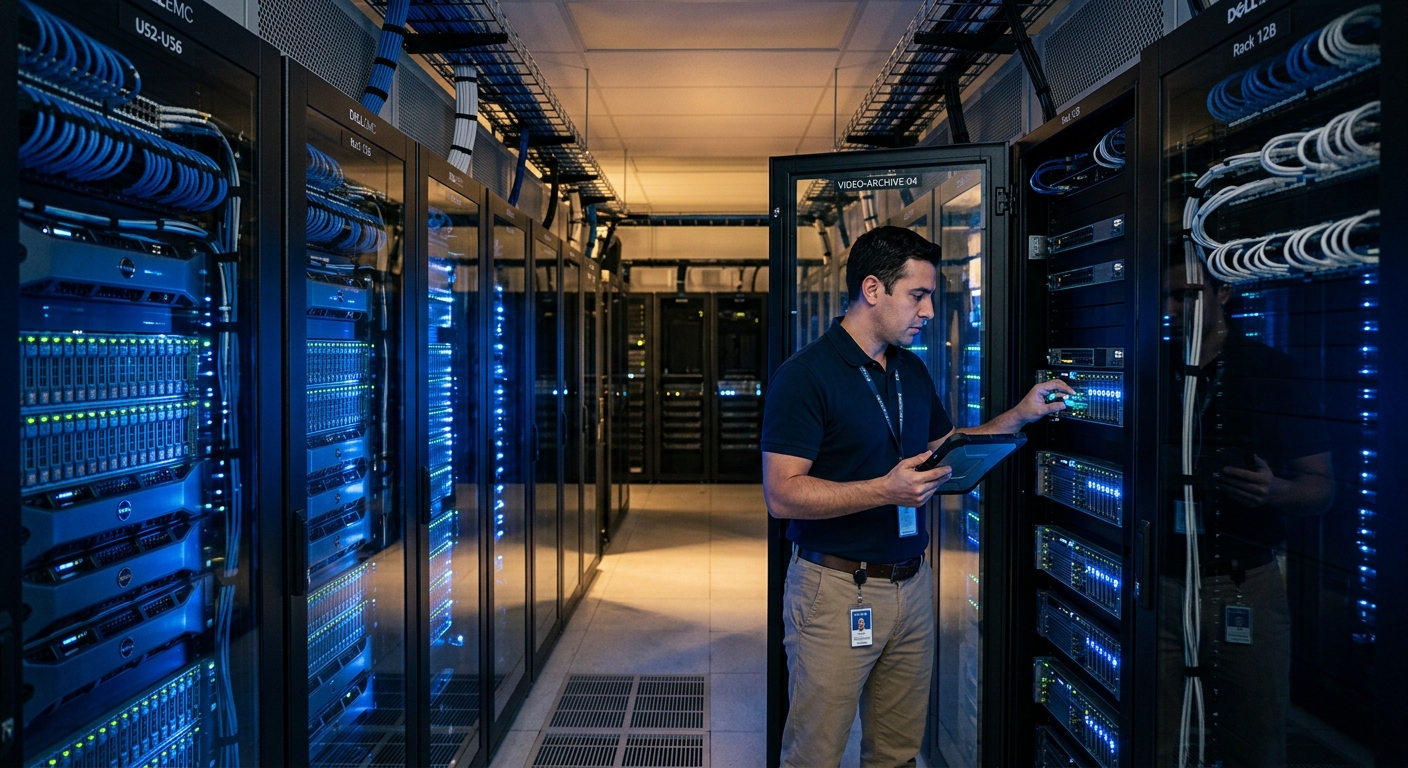
What Is On-Premise Video AI?
On-premise video AI is artificial intelligence software deployed inside your own infrastructure - your servers, your data center, your VPC - rather than processing video through an external cloud service. Your footage never leaves your environment. The AI models, the processing pipelines, and the outputs all live where you control them.
For media companies, broadcasters, and event producers handling sensitive or proprietary footage, this distinction is not a technical preference. It is a business requirement.
Why On-Premise Matters for Video
Video is not text. A single hour of broadcast footage can be several gigabytes. Uploading that to an external service introduces three problems that don't exist with on-premise deployment:
Data Sovereignty
Your footage stays in your environment. No third-party cloud vendor stores, processes, or has access to your content. You control retention, access, and deletion.
Bandwidth and Latency
Processing video locally eliminates upload time. A broadcast network producing 14 hours of daily content cannot afford to wait for cloud round-trips.
Compliance
Regulated industries - broadcast, government, healthcare - often require that content never leave a specific jurisdiction or network. On-premise is the only way to guarantee this.
Cloud-based video AI is a strong choice for many organizations - especially teams processing moderate volumes without strict data residency requirements. It offers faster setup, no hardware investment, and automatic scaling. But when the volume is high, the content is sensitive, or compliance obligations prohibit external processing, on-premise becomes the practical answer.
How On-Premise Video AI Works
The deployment model changes. The capability does not. An on-premise video intelligence engine performs the same functions as a cloud-based one - transcription, speaker detection, visual analysis, data extraction, asset generation - but runs entirely within your infrastructure.
Your Video Source
Camera, archive, live feed
Your Infrastructure
On-prem server or private VPC
AI Processing
All models run locally
Structured Outputs
Data stays in your systems
Your Tools
CMS, MAM, social, search
Your Video Source
Camera, archive, live feed
Your Infrastructure
On-prem server or private VPC
AI Processing
All models run locally
Structured Outputs
Data stays in your systems
Your Tools
CMS, MAM, social, search
The AI models are installed and configured for your specific content: your terminology, your speakers, your brand rules. Updates happen on your schedule, not the vendor's. Processing capacity scales with your hardware, not a shared cloud queue.
On-Premise vs. Cloud-Based Video AI
Cloud-Based Video AI
- Footage uploaded to vendor servers
- Processing speed depends on shared infrastructure
- Vendor controls data retention and access
- Compliance requires trust in vendor certifications
- Models are generic, shared across customers
- Costs scale with usage - unpredictable at volume
- Integration limited to vendor API
On-Premise Video AI
- Footage never leaves your environment
- Processing speed depends on your hardware - dedicated
- You control data retention, access, and deletion
- Compliance guaranteed by architecture, not contracts
- Models tuned to your content and vocabulary
- Fixed infrastructure cost - predictable at any volume
- Direct integration with internal systems
The choice is not always one or the other. Many organizations run a hybrid model: sensitive content processed on-premise, non-sensitive content in the cloud. A podcast network might process its public episodes through a cloud pipeline for speed and convenience, while keeping unreleased content and client recordings on local infrastructure. The right architecture depends on your content, your compliance requirements, and your scale - not on a vendor's preference.
Who Needs On-Premise Video AI
Broadcasters
News footage, unreleased programming, and live feeds are proprietary assets. A broadcaster cannot send unaired content to a third-party cloud for processing. On-premise deployment means the AI runs in the broadcast facility - same network, same security perimeter, same compliance framework.
Enterprise Event Producers
Corporate events often include confidential presentations, internal strategy discussions, and executive communications. Event producers serving enterprise clients need to guarantee that video content is processed without leaving the client's approved environment.
Government and Regulated Industries
Organizations bound by data residency laws, security clearances, or sector-specific regulations cannot use cloud processing for video content. On-premise is not optional - it is the only architecture that meets the requirement.
The Real Cost Comparison
Cloud pricing for video AI is typically per-minute or per-hour of processed content. At low volumes, this looks affordable. At broadcast scale - hundreds of hours per month - the math changes.
Cloud Pricing at Scale
- Per-minute charges grow linearly with content volume
- Upload bandwidth costs add to processing fees
- Vendor price increases are outside your control
- Each new use case adds another line item
- Archive reprocessing means paying again for old content
- Budget is unpredictable quarter to quarter
On-Premise Economics
- Fixed hardware investment - known, depreciating cost
- No bandwidth charges for local processing
- Processing capacity owned, not rented
- New use cases run on existing infrastructure
- Reprocess your archive as often as needed at no marginal cost
- Predictable annual budget regardless of volume growth
For organizations processing more than a few hundred hours per month, on-premise deployment typically reaches cost parity within the first year - and becomes significantly cheaper in year two and beyond.
What to Look For in an On-Premise Video AI Solution
Not every vendor that claims "on-premise" delivers the same thing. Some install a lightweight agent that still sends data externally for processing. Others offer a container that runs locally but requires constant cloud connectivity for model updates or licensing checks.
A genuine on-premise video AI deployment means:
- All processing happens on your hardware, with no data sent externally
- Models run locally without requiring internet connectivity
- You control update timing and versioning
- The system integrates directly with your internal tools - CMS, MAM, search, storage
- Configuration is specific to your content: your speakers, your terminology, your brand rules
Speechbox builds video intelligence engines that deploy both ways - fully on-premise in your own infrastructure, or as a managed cloud service when that fits better. The architecture adapts to your requirements, not the other way around.
In Practice: A Broadcast Network's Shift
A national broadcast network was using a cloud-based transcription service for its daily news output - 14 hours of live programming per day. The service worked well enough for basic transcripts, but three issues kept escalating.
First, upload time. Sending hundreds of gigabytes of raw footage to an external server every day consumed bandwidth the engineering team needed for live operations. Second, a compliance audit flagged that unaired footage - including segments killed before broadcast - was being stored on a third-party server with no clear retention policy. Third, the per-minute pricing that seemed reasonable at launch had grown to a six-figure annual line item as the network expanded its digital output.
The network moved to an on-premise video intelligence engine. Processing now happens on hardware in their own facility, on the same network as their broadcast infrastructure. Unaired footage never leaves the building. The transcription and clipping pipeline runs automatically on ingest - no upload step, no external dependency, no per-minute charges.
The transition took weeks, not months. The hardest part was not the technology - it was convincing the finance team that the upfront hardware investment would pay for itself within a year. It did, in seven months.
Not every organization needs this. A production company processing 20 hours of content per month would likely be better served by a cloud solution - faster to set up, no hardware to maintain, and the cost stays manageable at that scale. The inflection point is different for every team.
Related Terms
- Video Intelligence Engine - A purpose-built system that performs video-to-data processing at scale. Can be deployed on-premise or in a private cloud.
- Video-to-Data - The core process of extracting structured, searchable information from video content.
- Data Sovereignty - The principle that your data - including video content and its derivatives - stays under your control and within your chosen jurisdiction.
- Speaker Detection - Identifying and tracking speakers across video content. On-premise deployment ensures speaker data remains private.
Related Questions
- What is a video intelligence engine?
- What is video-to-data?
- How do TV channels automate video content processing?
- What is data sovereignty for video content?
- How does speaker detection work in video?
- What is the difference between cloud and on-premise AI for media?
Want to see how this works on your footage?
Let's connect